Bernard-Henri Lévy © AFP
The French philosopher and novelist Bernard-Henri Lévy became interested in Libya from the very first confrontations on Tahrir Square. During his first journeys, he took notes on everything he saw, in a country both ablaze and awash with blood. The idea of a film gradually formed in his mind, and thus was born The Oath of Tobruk, co-directed with Marc Roussel.
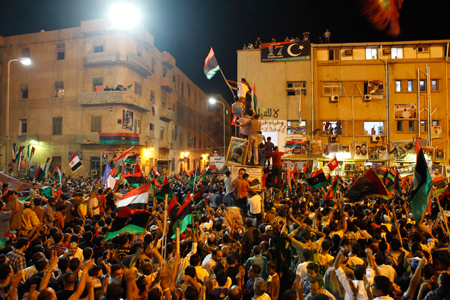
In Tripoli and Benghazi as in Paris and Washington, the war against Gaddafi as told in The Oath of Tobruk explores the international impact of the fall of the dictator. The many return journeys made by Lévy and his team exposed him to the experiences of the key actors in this war, both on the front and in the wings.
Four key characters dominate the film: Suleiman Fortia, symbol of the Libyan Resistance, Mansour Sayf Al-Nasr, in exile in Paris and first ambassador of free Libya, Ali Zeydan, BHL’s special contact in the National Transitional Council, and the secret negotiator Mustafa El-Sagizly, who trained the Libyan youth in armed resistance.
Lévy’s original aim in heading for Libya was to make a film report with Marc Roussel. His travelling companion in both Iran and Afghanistan unpacked his Canon 5D, and caught up in the power of the events all around him, filmed the scenes unfurling before his eyes.
“It was only later that we decided to make a film and realised in fact we still had all those scenes we’d thought were lost,” says Lévy. The French intellectual was inspired by his experience in Libya to write two books: La Guerre sans l’aimer and Journal d’un écrivain au cœur du printemps libyen. The Oath of Tobruk is a natural extension of this work.
TK
The film screens on Friday 25 May at 7.45 pm, Salle du Soixantième, in a Special Screening.
Bernard-Henri Levy will attend the Festival de Cannes’ red carpet, Friday evening, with Libyan rebels and two anonymous opposition figures to the Damas government.
► Read more about the AFP news