Xavier Dolan © FDC / C.Duchene
Cinema’s child prodigy has grown up. After five films in five years and a Prix du Jury in 2014, Xavier Dolan is back to Cannes within the ranks of the Jury chaired by the Coen brothers. Interview on the heart of the creative processes of a rocket-powered genius.
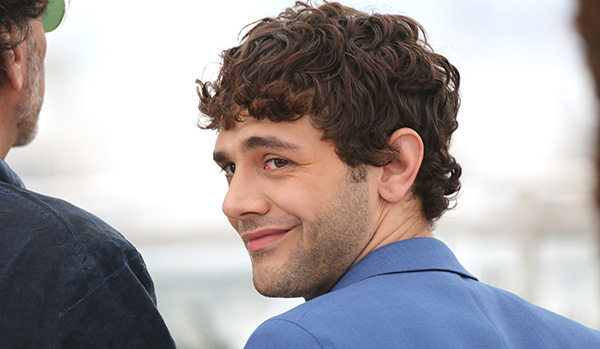
Xavier Dolan © FDC / C.Duchene
We know your films, but we know less about the films you love, apart from Jane Campion and Titanic. Which are the films you can watch again and again?
I can always watch Titanic. I know it off by heart. It’s not even a film to me anymore, it’s a dictionary. For me, it’s a backdrop, a backdrop to life. I could also watch Au revoir les enfants and Claude Sautet‘s films without ever getting bored: The Things of Life (Les Choses de la vie), Max and the Junkmen (Max et les Ferrailleurs), Un Cœur en hiver…
You have said yourself that your love for cinema developed late. Is that what gave you your own unique style?
I suppose so, yes. I never have references in mind. I wanted to honour Wong Kar-Wai in quite a naïve, almost plagiarist way. But never again since then, as I didn’t have time to watch films and catch up. The period in my life when I had time to watch a lot of films was very short.
So what are your other sources of inspiration?
My real sources of inspiration for films are photography books, paintings, and poems… All the other mediums inspire me more for cinema than cinema media does. Cinema influences me, but photography, sculpture, literature, and poetry inspire me. Inspiration is like a murmur, or like a secret in a huge crowd which is whispered from ear to ear. Once it reaches the end of the crowd, the secret has been completely deformed. To me, that’s inspiration. It’s seeing a photo which transports me somewhere completely different.
Five feature films between the ages of 20 and 25. Filming seems instinctive to you. Where does this deep desire to create come from?
It comes when it comes, I couldn’t do it on demand. I’m not conditioning myself to make a film every year. And actually, I haven’t always done it. After Heartbeats (Les Amours imaginaires), I worked on Laurence Anyways for a year and a half.
And when you’re not working on a film, what do you do?
I wait. My occupation in life is writing films. It’s my passion. I wanted to go back to studying, but I had to promote Mommy. I wanted to learn. I don’t have an education; my knowledge is totally cobbled together. I’d like to develop my personal culture.
How do you see yourself in twenty years?
I’d like to do this all my life, but I can’t tell you where I’ll be in twenty years. There aren’t really any times in my life when I’m not in the process of writing or thinking about a film. It’s always come naturally, even if I didn’t know it before.
Tell us a little about your muse, your friend and long-time collaborator Anne Dorval. To what extent do you involve her in your creative process?
I always write while thinking about people. What’s even better when you know the person is really creating a tailor-made role for that person. When I say tailor-made, I mean a role which is the opposite of their personality and comfort zone. That’s the real challenge for me as a director and for her as an actress: going elsewhere.
This year, you’re on the side giving out the prizes. How do you approach appreciating a film?
With my heart. With my head, I remind myself to prioritise my heart. Not my personality, my reflexes, my wishes, my desires, but those of the characters, the story, and the film. What does the film need? That’s how films are intellectualised on film sets. There are the things you plan and calculate, things which are mathematical. And then there are the things you do instinctively on set when you’re creating. That’s the art factor, the little part of real art. That’s what Marcel Duchamp wrote in a manifesto. The very small percentage of what the director unconsciously does which is artistic. As long as there’s that, as long as there’s still a bit of spontaneity, there’s art, and there’s a film.
Interview by Tarik Khaldi