In 2004, Tony Gatlif picked up the Best Screenplay prize at Cannes for Exils. The filmmaker returns for the third time this year to the Official Selection to present Geronimo, a love story set against the backdrop of a war between two gangs from different cultures. A militant and musical film that captures the essence of the man and his filmography.
How would you describe Geronimo ?It’s a sort of “Romeo and Juliet” for our times. I really want to make a contemporary film and create a role for Céline Sallette. I drew my inspiration from a teacher whom I knew while I was growing up in a difficult part of town. He was a sort of
James Stewart who always wanted to right the wrongs he saw around him.
It seems your encounter with Céline Sallette was pivotal in making this film…
Absolutely. I changed the entire film for Céline. To start off with, I wanted Geronimo to be a man. When I met her, I immediately had the idea of a female teacher working in a difficult district in the south of France. Her daily life is turned upside down when a young Turkish minor decides to escape a marriage arranged by her parents in order to run away with her boyfriend, who is of Gypsy origin. This event really sparks things off in the district and the central character played by Céline does everything within her power to stop the whole thing exploding..
How did you picture the film in visual terms?
The decor played a major role in the edit of Geronimo. The film takes place right in the middle of August. I visualised the district as a place without walls. I asked my assistants to find somewhere outside a city, but which was still very urban all the same. the idea was to have the camera move quickly. This speed is a perfectly reflects today’s youth and of the young people I filmed: they move fast, they talk fast, they walk fast and they have their own language.
Most of the actors in the film are nonprofessionals, Why?
It’s true, most of them are unknowns. They’re between 17 and 18 years old. It was really important for me to take advantage of the freshness. A bit like in Pasolini‘s films. These are kids from the street, who come from very poor and disadvantaged families. I had to have real kids, with a language all their own and who knew all about life out there on the streets.
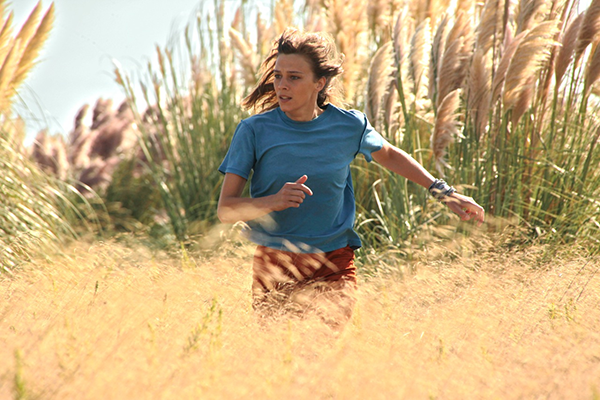
Photo of the film © RR
As in all your films, music plays an important role in Geronimo. It’s right there when the gangs confront each other during their “battles”…
Right from the writing of the screenplay, I began to work on the music with Delphine Mantoulet. I absolutely wanted each scene to have a musical accompaniment, but not a soundtrack in the traditional sense. I wanted the music to play a role, and to move like the young people in the film. In one scene, where the two gangs come face-to-face, it was the actors themselves who made the music, hitting a pole with a club, or using knives on the wire fences. That gives the film a certain sense of tempo. The sound of this percussion makes the scene violent even though not a single drop of blood is shed. It was very important for me to distance myself from the reality of violence.
But Geronimo is still imbued with a certain sense of violence…
Geronimo is an anti-violence film even if, at certain points, it was important for the film that violence break out. I didn’t want to show it directly. It’s expressed mainly through the music.
It’s been 40 years since you began and your films still have a very militant feel. How has the world changed in your opinion?
I think it’s getting worse and worse. I am permanently outraged by what I see going on. Here I’m telling the story of a young woman threatened by her brothers because she didn’t want to marry one of her cousins… There are stories like that all over the world, and portraying them is one way of denouncing them.
Reported by Benoit Pavan
SCREENING
Tuesday 20th May / Buñuel Theatre / 8:00 p.m.
>> View the interactive calendar