Ethan et Joel Coen © Getty Images / Oleg Nikishin
For three decades now, they’ve been caricaturing the world through their eccentric heroes living out on the fringe. Whatever the genre, Joel and Ethan Coen have imposed the quirky vision of life in which their humour – always darkly ironic – is a breath of fresh air. From Blood Simple (1984) to Inside Llewyn Davis (2013), some of the most famous faces in American cinema have been given the once-over by their camera. An off-beat interview with a couple that’s never less than caustic.
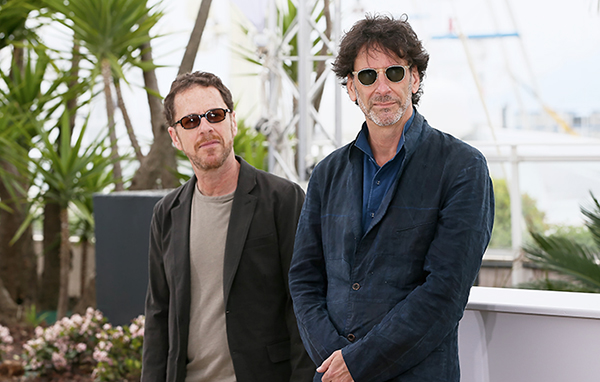
Coen Brothers © Getty Images / Oleg Nikishin
Among all the movies you’ve made, which one would you choose to live in?
Joel Coen: I don’t think I want to live in any of them ! They’re all a little rough. We don’t even want to watch our movies again. We let them alone, living their lives. We never watch our movies again once they’re finished. I don’t think either of us is curious to live in the world in any of these movies. We prefer our own life !
If you could change the end of one of your movies, which one would you pick up and how would it end?
JC: I don’t know if you remember the end of No Country For Old Men. Tommy Lee Jones‘s character, sherif Bell, is sitting in front of a window and he’s telling a long story to his wife. It’s a long take looking at him in the window, in the background. We thought that perhaps, what we should have done, is that half way through the story, you see a car stopping, within the distance, across the field, on the road, and someone gets out of the driver’s seat and starts walking towards us. And it’s Anton Chigurh, the character played by Javier Bardem, carrying his gun. You see him slowly approaching the house.
EC: And sherif Bell’s wife doesn’t know about it because she’s listening to his boring story. We actually wrote another alternate ending, which I thought my brother was going to talk about. Instead of having Tommy Lee Jones telling the story, we had Cormac McCarthy, the author of the novel, leaning on the fence, telling the story directly to the camera. And when he finishes it – he’s wearing cowboy chaps made of leather -, and as he turns around and walks away, we see that he has no pants under the chaps ! And that’s then end of the movie.
JC: So we wrote many endings for that! But you’re stuck with the one you get!
With which of your characters would you agree to go on holidays with?
JC: Probably Billy Bob Thornton from The Man Who Wasn’t There (2001), because he has the good sense to keep his mouth shut !
EC: He wouldn’t get on your nerves ! For me, it would be Steve Buscemi, from The Big Lebowski (1998). He’s easy to take.
Which cinema genre most closely matches your daily life?
JC: Certainly not a western !
EC: None of it is like our daily life. Cinema is an escape from daily life. A Serious Men (2009) was about our lives, more or less, when we were kids. Our lives at that time, not our lives now.
Which kind of shots best illustrate your personality?
JC: I suppose at this point in our lives, it’s a small fade out. We’re getting older !
If you could set the world to rights with any director, having a drink, who would it be?
EC: Maybe Erich von Stroheim. It could be interesting. His English is excellent. I would not ask him anything in particular, not even about cinema. I’d just enjoy talking to him.
Which movie soundtrack has haunted you so much that you wanted to kill somebody?
JC: The classic one you would mention is this zither theme in The Third Man (Carol Reed, 1949). That stays in your head until you get irritated by it.
EC: Yes, The Third Man ! There’s also a movie with David Bowie called Merry Christmas Mr Lawrence (1983). I thought about that for a couple of years, it went round inside my head.
Which movie opening do you like most?
EC: I’m ashamed not to be original because everybody likes that but every once I think about Once Upon a Time in The West, by Sergio Leone.
35 mm or digital: who wins the match?
JC: Digital is going to win. It has to and already has. It won. I think the question is whether 35 mm will last as a minority choice. You need to have choice. The more options you have, the better it is.
Interview by Benoit Pavan
(Thanks to Sarah Combette-Molson)