Film Still Marius © RR
Buoyed along by a booming market, film restoration is an expanding industry, especially in France, where it enjoys considerable financial support. Since the early 2000s, the Festival de Cannes has dedicated the Cannes Classics selection to it, which opens this Thursday with a documentary celebrating Orson Welles. Here’s a quick rundown of the main steps involved.
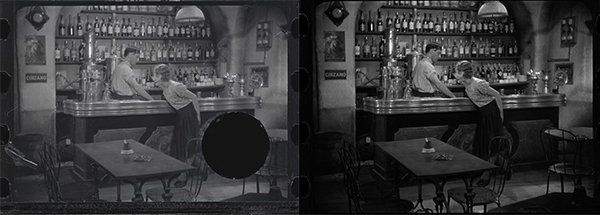
Film Still from Marius by Marcel Pagnol © RR
1 – “Mechanical” reconditioning. Restoration begins with the repair of the original negatives so that they can withstand machine processing during digitisation. The original splices between each frame are reinforced or remade if they’re weak. Damaged perforations and tears on the film are fixed. The length of time required for this step depends on the age and condition of the film. On average, it takes a month.
2 – Cleaning and digitisation. Once repaired, the negative is cleaned: it is passed through a machine that gets rid of ingrained dust by emitting ultrasound waves. The film is then scanned and digitised. Thousands of files will be created, as many files as there are images on the negative.
3 – Restoring the image. All the signs of wear accrued over time are erased image by image using a graphic palette and software, these include scratches, stains, fragments of gelatine and stamp marks. The software uses the images before and after the faulty image to rebuild the area that needs repairing.

Film Still from Marius by Marcel Pagnol © RR
4 – Image calibration. The technicians readjust the colorimetry of the colour negative, or its density if it’s a black and white film. It’s an important stage, because the success of the finished product depends on the consistency of the frames between each other and maintaining the film’s visual identity.
5 – Sound digitisation. This process takes place alongside image calibration. The negatives, of “variable” or “fixed” density, are scanned and digitised. General surface noise, contrasts and levels of saturation are controlled. The “pops and ticks” are removed so that the voices can be heard clearly.
6 – Photochemical back-up. When digital restoration is complete, the film is printed on a polyester negative to ensure it is safe in the long-term; the efficiency of digital back-ups is as yet unknown.
Benoit Pavan