LOVE CIRCLE
Newly restored and presented at Cannes Classics, Giuseppe Patroni Griffi’s Metti, una sera a cena (Love Circle) returns to the Croisette more than 50 years after its presentation in Competition at the Festival de Cannes in 1969. The film’s poster reveals the context surrounding its creation: the sexual revolution of the 1970s.
A woman lies across a bright red sheet. Faces in black and white vignette cutouts in the style of a photo novel. Pop typography with yellow letters on a bright blue background. The poster for Metti, una sera a cena (Love Circle) is typical of Italian cinema of this time, at the boundary of the 1960s and 1970s. This glamour, portrayed by a sensual brunette, with a voluminous hairstyle and a smoldering gaze freezes this dated aesthetic in time, for better or for worse.
Adapted from a written work by Patroni Griffi himself, the film follows multiple bourgeois couples in Rome, trapped in a web of love made of jealousy, infidelity and frustration.
Brazilian actress Florinda Bolkan dominates the poster, wearing a jumpsuit split all along the side, which is both futuristic and more than suggestive. This image, clearly indicative of the 1970s, represents both a liberation of moral values but also an era in which women’s bodies were being used for publicity, playing on the enduring fantasy of the “femme fatale”.
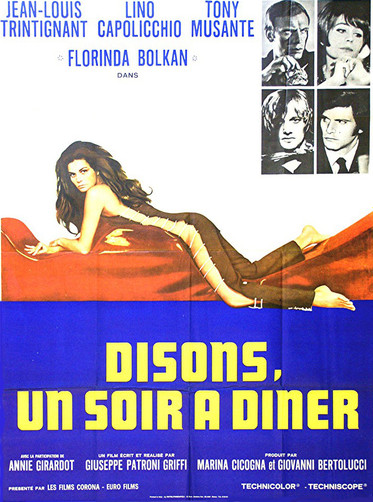
A prestigious and international cast appears around Bolkan, comprising Jean-Louis Trintignant, Annie Girardot, Tony Musante and Lino Capolicchio. Separated like mismatching puzzle pieces, they are locked in frames. Such a composition speaks to the film’s power dynamics: at its heart, an object of lustful desire and alongside this, games of love and chance.
Moreover, and although their names do not officially appear on the poster, the film brings together immense talents from the cinema of the time. Dario Argento wrote the screenplay before his debut in the giallo genre, while music is by Ennio Morricone.
An SND (Groupe M6) presentation and restoration in association with the Cineteca Nazionale (Rome). Distributeur France: Les Films du Camélia.
The work was carried out by L’Image Retrouvée in 4K, from the original image negative and the sound negative.
In the presence of the film’s screenwriter Dario Argento, a director, screenwriter and producer.