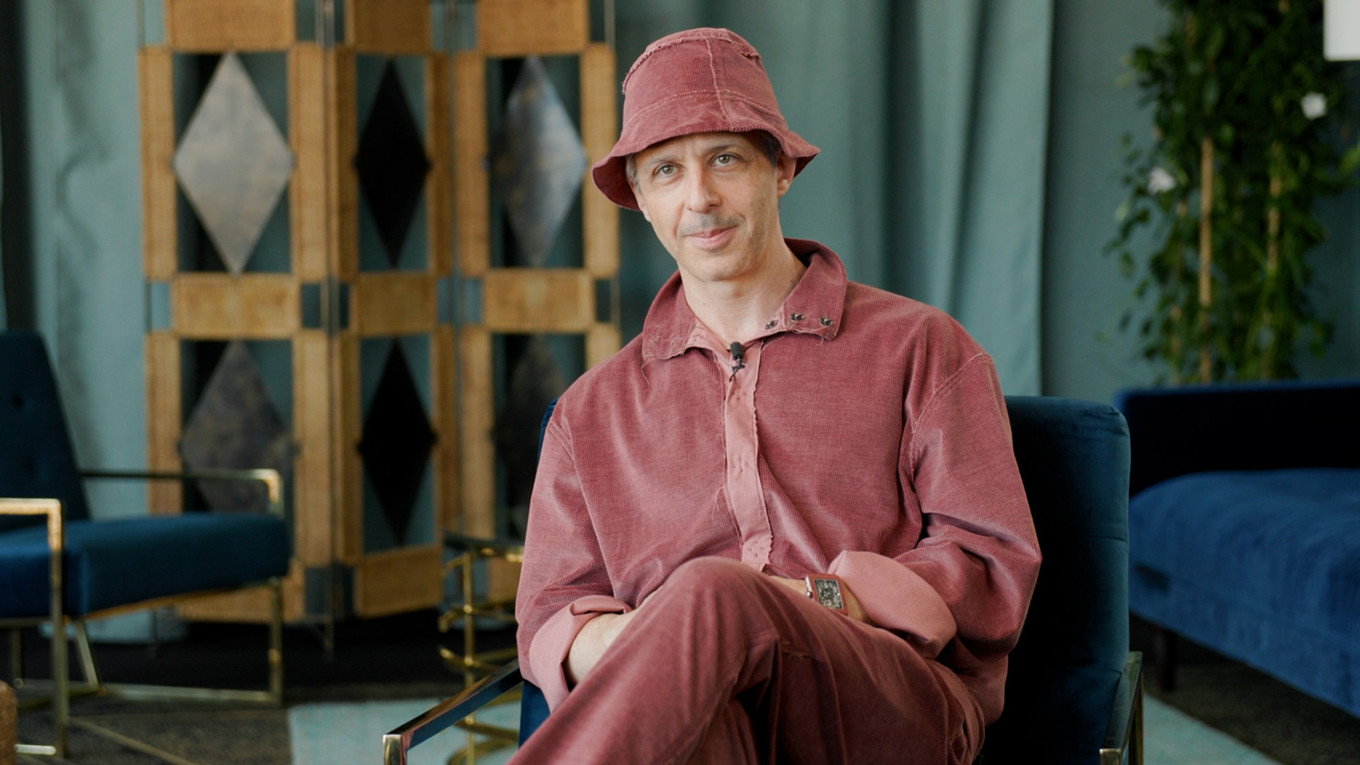


Interview with Jeremy Strong, member of the Feature Films Jury
After achieving global success through his role in the series Succession, Jeremy Strong belongs to that breed of actors who truly become their characters, so much so that they fully disappear inside them. Strong, always in search of authenticity, has worked on projects with boundless intensity. Sensitive to political and climate issues, he continues to steer his career towards demanding films, guided by an undiminished passion for deep, living cinema.
Do you remember the first acting performance you saw that made you fall in love with the big screen?
There have been a lot of seminal moments for me. Performances that moved the earth under my feet. It’s hard for me to pinpoint one of them in particular, but I can still recall Peter Mullan’s brilliant and devastating performance in Ken Loach’s film My Name Is Joe, for which he also won the Award for Best actor in Cannes in 1998. I could also cite Dustin Hoffman in Midnight Cowboy and Kramer vs. Kramer, Daniel Day-Lewis in My Left Foot, Robert De Niro in Raging Bull or Isabelle Huppert in La Pianiste (The Piano Teacher). And how can you not be inspired by Juliette Binoche, whose work is absolutely flawless in my eyes? She embodies raw honesty, fearlessness, and versatility.
What relationship do you have with acting?
When I was a child, I’d often play-act. I was also in community theatre groups. It was more than a passion, for me, acting has always been an obsession. Even I don’t really understand why it’s so deep-rooted within me. It’s been part of my life since I was four or five years old. I see it as a kind of escape. And since then, things have evolved. Now, I’m more interested in revealing the truth by shedding any artifices. Each character possesses a different filter through which we are trying to find this truth.
How do you prepare for a role when searching for this truth?
I think the most important thing is to be open to your intuition and instinct. Listening to your intuition and instinct is how we remain alive and open to learning. It’s about making what you are doing believable. Sometimes, I need to dig down even deeper to get to that place. If you don’t do that, then your work risks being superficial. Some actors have the gift of being able to turn this on and off. In my case, I need to liberate myself of certain things to be able to access the type of freedom and understanding that I need. Then I protect it fiercely. I remember Sean Penn once told me that you have to be a bodyguard for your character, and I think that’s true.
“I believe in the power of art and cinema, in their capacity to touch and change hearts and minds”
What role has changed you the most on both a human and artistic level? Your character in Succession, Kendall Roy, naturally comes to mind…
I spent seven years of my life working on this character, but I already feel like it happened to someone else. I no longer identify with it really. It was a challenge in many respects, because it led me to tread paths I’d never walked before as an artist, and forced me to take risks. But the role that has probably changed me the most is the one that I’ve just finished. I was recently shooting a film about Bruce Springsteen. The character of Jon Landau, the music agent who discovered Springsteen and who I play in the film, had a profound effect on me. He invited me to commune with Bruce and his music. Together, he and Jon Landau have contributed to the spiritual enlightenment of the people. I myself also felt enlightened and fulfilled.
Just like Bruce Springsteen, you are also very engaged. Do you think that actors today have a political or moral responsibility that goes beyond artistic performance?
It’s an important question. For most of my life, I’ve believed — and maybe still believe — that my way of participating in events and debates and issues of our time is indirectly, through storytelling. For example, last year I did a play by Norwegian playwright Henrik Ibsen because, for me, it was an allegory for the climate crisis. There’s also The Apprentice which is about Donald Trump and the rise of fascist ideology. So I’d say that it’s very important for me to be part of a world that reflects our own. I very much believe in what Shakespeare writes in Hamlet, that our job is to hold a mirror up to nature and to show the very age and body of the time, its form and its pressure. I think that is what I feel my mission is as an actor.
And as a citizen?
We all need to act according to our conscience. But our world is on fire. It seems like the moment has come for everyone to wake up as a citizen of the world, in whatever form that takes. I’m personally involved in an organization trying to address the climate crisis. To me, this crisis is incredibly urgent. I fear that, very soon, we’re going to see the consequences of our actions. But my way of confronting it is also through my work. I believe in the power of art and cinema, in their capacity to touch and change hearts and minds.