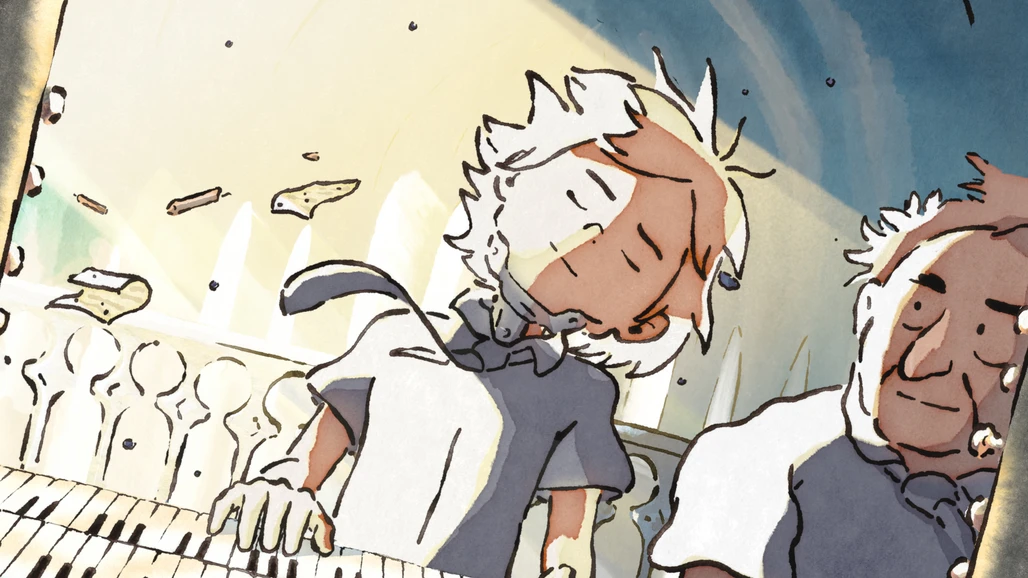
IRON BOY © Eddy Cinema, Beside Productions, Regular Production, France 3 Cinema, Auvergne Rho^ne-Alpes Cinema, RTBF
IN THEATRES ON 14 OCTOBER – Le Corset (Iron Boy), directed by Louis Clichy, was awarded the Special Jury Prize at the Un Certain Regard awards ceremony in Cannes last May. It is now playing in theaters across France!
[Looking back at its Cannes premiere]
After Astérix: le Domaine des dieux (Asterix: The Mansions of the Gods) in 2014 and Astérix: le Secret de la potion magique (Asterix: The Secret of the Magic Potion) in 2018 with Alexandre Astier, Louis Clichy unveils a new animated film with Le Corset (Iron Boy), shown in Un Certain Regard. This new work depicts a father and son in the Beauce region in the 1980s.
How did this project come about?
Le Corset (Iron Boy) is a project that I have been working on for a long time. It originated from a strange image that I enjoyed animating, one of a boy in a corset, standing as straight as the letter I in an expanse of flat fields and who flips the horizon when he leans his head. More recently, as I transitioned from son to father the story came back to me, along with the need to explore the father-son relationship in a tragicomic way. In this rural setting, which remains very traditional, being a farmer is passed on from father to son as a matter of course, open conversations are difficult, introspection is impossible, and feelings are taboo. This is fertile ground for the unspoken, frustrations, and bodily manifestations of emotional distress. That is what happens to Christophe when he starts leaning.

Can you share a few words about your actors?
When it comes to animation, there’s always a little wariness about actors, their fame, and their image. So I decided to hold open auditions in the region where the story is set, to find performers we would then animate, to maintain a sense of realism that’s almost documentary-like. I always prefer a bit of roughness in diction to over-the-top acting. In the family, only Rod Paradot is a professional actor but is entirely self-taught. He plays the older brother. For the characters from outside the rural setting—the organist, the girlfriend, the priest—I called on Alexandre Astier, Brune Moulin, and Jean-Pascal Zadi, who bring a variety to the acting that I really like. But in an animated film, you clearly have to include the animators among the performers, as they are the ones bringing the characters to life and making decisions about their physical movements.

What have you learned in making this film?
It’s my third film, but it’s really my first personal film. Initially, I was arrogant enough to think I had complete control over what I was saying about myself. I had built up strong defenses, but the unconscious mind always finds a way to break through. For example, it took me a long time to figure out what Christophe’s parents looked like. I kept changing a nose, a tuft of hair, a demeanor—over and over again. After a few months of work, I showed it to my family. It was an almost perfect likeness of my parents. With my nose glued to the paper, I hadn’t even realized it. So, in answer to the question, what I learned was that a director doesn’t really have much control.
What are your influences?
It was sound that first drew me to animation—Disney cartoons narrated on audio cassettes, and then I was always drawing. That passion has never left me. I still approach animation through the lens of sound and music. At the Sorbonne, where I took a course in cinema, I discovered directors like Moretti and Haneke—you could say that they have nothing to do with my film, but I love Haneke’s obsessive rigor, his refusal to include a score in his films. Moretti is so good at portraying families. It’s hard not to think of him when you see a shot of a family in a car.