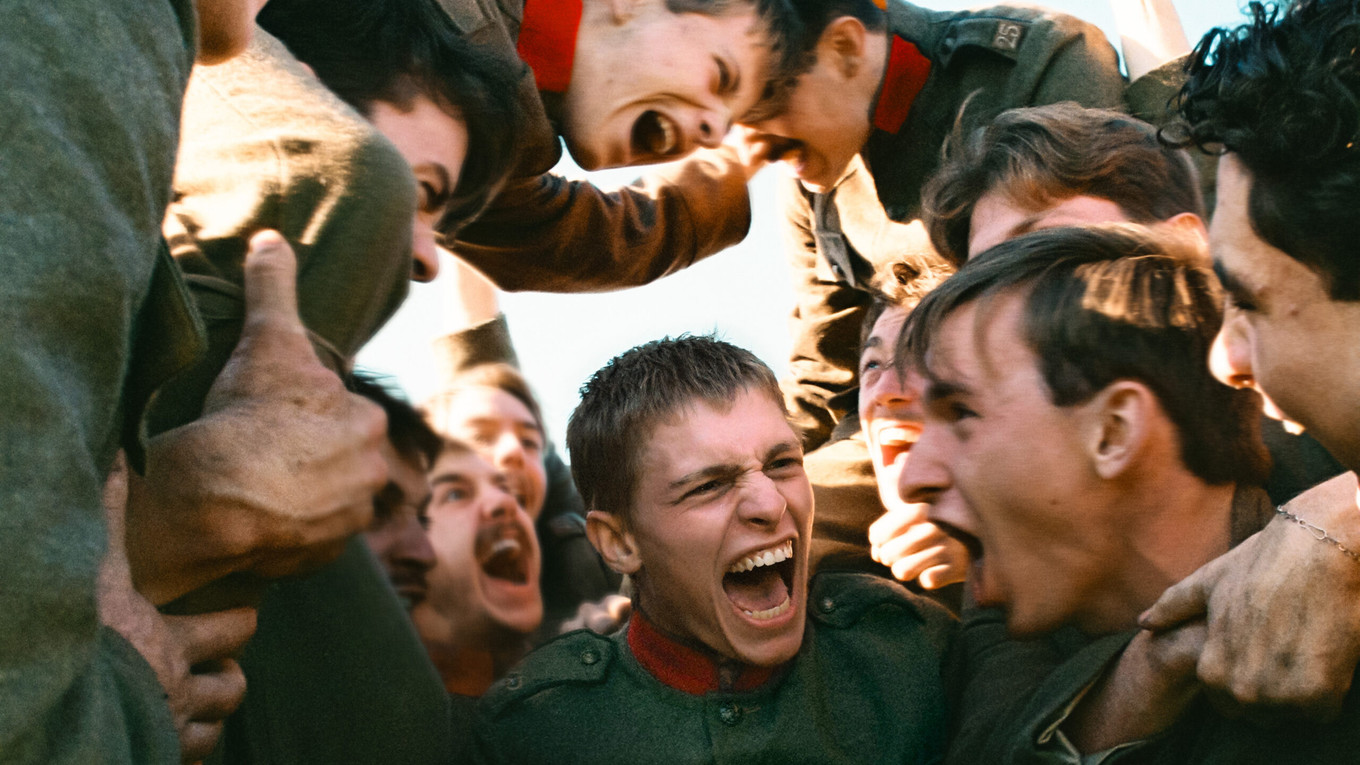
COWARD © AlineBoyen_theReunion
After winning the Caméra d’or for Girl (2018) and the Grand Prix for Close (2022), Lukas Dhont returns to Competition with Coward. The Belgian director reinvents the war movie, and dares to tell a bittersweet love story set just behind the front line in 1916.
What was the original image behind Coward?
I came across a black-and-white photo inside a book in a bookstore in Paris. It showed men dancing on a stage, and when I looked closely, I saw that they were wearing skirts made from sandbags and jewelry made from old ammunition. When I began talking to historians about it, they told me that since the dawn of time, in every army, men waiting to return to the front lines have turned the tools of destruction into art as a way of escaping from their reality, even if only for a moment. I was seeing these images for the first time, and it inspired me to explore them as part of a project about memory.
What kinds of masculinity did you explore in these characters who were at war?
We live in a world where images of brutality, battlefields, and destruction — images associated with men and patriarchy — are emphasized more than images of cooperation, emotion, and intimacy. Men also tried to express themselves more freely. In soldiers’ diaries, there are accounts of men sleeping together, sharing beds, and one man who dressed up as a mother to give the others a kiss at bedtime… None of this is fiction or fantasy.
In the film, where does the cowardice referred to in the title come in?
There is a certain tension behind this negative term. The film explores the theme of fear — both the fear of the enemy and the inner fear that cannot be expressed. In this film genre, courage and cowardice are always linked to a person’s capacity for violence. It’s more about questioning than judging.
How did you go about casting two such opposing characters in the film?
For the character of Pierre, a farm boy, my idea was to visit agricultural schools in Belgium. Emmanuel Macchia was in the courtyard and came over to talk to me, and what was beautiful was that he was whispering. And that’s exactly what Pierre’s character is like — someone whose voice gets lost in the group at first. By contrast, Francis’ character is the extrovert, so we were looking for a dancer, a singer, and a performer. It wasn’t what Valentin Campagne did professionally, but when he spoke, when he moved, you were curious to see what he might do next. Combining these two energies created the perfect magnetism to tell a love story.